


The banking sector remains one of the most targeted industries for cybercrime globally—and Kenya is no exception. As financial institutions continue to digitize services, integrate mobile banking platforms, and expand digital infrastructure, the attack surface grows significantly.
Cybercriminals are no longer relying on simple phishing emails. Today’s attacks are highly coordinated, persistent, and specifically designed to exploit weaknesses in financial systems, networks, and employee awareness.
For banks, cybersecurity is no longer just an IT concern it is a strategic risk management priority that directly affects operational resilience, regulatory compliance, and customer trust.
Below are some of the most critical cybersecurity areas every bank must continuously strengthen.
1. Endpoint Security: The Most Common Entry Point
Every laptop, workstation, ATM terminal, and remote device connected to a bank’s network represents a potential entry point for cybercriminals.
In many breaches, attackers do not target core banking systems directly. Instead, they compromise a single employee endpoint through phishing or malware and use it as a gateway into the wider network.
For financial institutions, effective endpoint security must include:
- Advanced endpoint detection and response (EDR)
- Continuous monitoring of user activity
- Automated threat detection and containment
- Secure remote access controls
Without strong endpoint protection, attackers can move quietly within banking systems before detection.
2. External Cyberattacks Targeting Financial Institutions
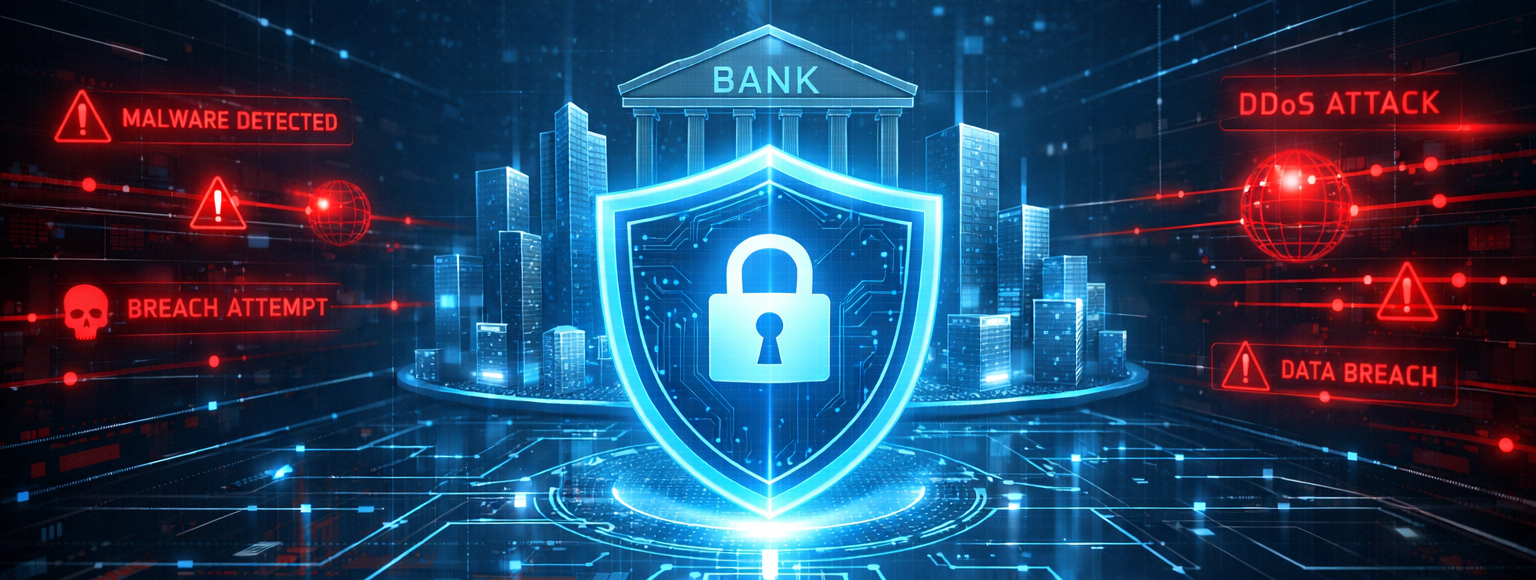
Banks face a constant barrage of external cyber threats, including:
- Phishing campaigns targeting banking staff
- Ransomware attacks disrupting operations
- Credential theft targeting financial systems
- Advanced persistent threats (APTs)
These attacks are increasingly sophisticated and often designed specifically for financial institutions.
A proactive cybersecurity posture helps banks detect threats early, reduce attack impact, and maintain operational continuity.
3. Network Security: Preventing Lateral Movement

Once attackers gain initial access to a banking environment, their next objective is to move laterally across systems.
Weak network segmentation or poor monitoring allows attackers to explore internal systems undetected.
Modern banking networks must prioritize:
- Network segmentation between systems
- Continuous network traffic monitoring
- Zero-trust architecture principles
- Real-time anomaly detection
Strong network security ensures that even if a breach occurs, the damage can be contained quickly.
4. Backup and Data Protection: Ensuring Operational Resilience

For banks, data availability is critical. Transaction records, customer data, and operational systems must remain secure and recoverable at all times.
Without secure and regularly tested backups, ransomware attacks can result in:
- Operational downtime
- Data loss
- Regulatory penalties
- Loss of customer confidence
Robust backup strategies should include secure offsite storage, encrypted backups, and routine recovery testing.
5. Firewall Protection: The First Line of Defense

Firewalls remain one of the most important defensive layers in banking cybersecurity infrastructure.
However, many breaches occur not because firewalls are absent—but because they are misconfigured, outdated, or poorly monitored.
Modern firewall solutions help banks:
- Detect malicious traffic
- Block unauthorized access
- Monitor suspicious network behavior
- Strengthen perimeter security
When properly configured and integrated with monitoring systems, firewalls become a powerful defense against external attacks.
Beyond Technology: Building Cybersecurity Skills in Banking Teams
Technology alone cannot secure banking systems. Human awareness and expertise play a crucial role in preventing and responding to cyber threats.
Cybersecurity training allows banking professionals to:
- Identify emerging cyber threats
- Respond effectively to incidents
- Understand real-world attack scenarios
- Strengthen internal security culture
Hands-on demonstrations and training environments help teams build practical cybersecurity readiness—not just theoretical knowledge.
Strengthening Cyber Resilience for the Future of Banking
As digital banking continues to evolve, cybersecurity must evolve alongside it.
Financial institutions that invest in strong infrastructure, proactive threat monitoring, and continuous training will be better positioned to protect their systems, customers, and reputation.
Building cyber resilience today ensures that banks remain secure, trusted, and prepared for the challenges of tomorrow.

 Chat with Us