


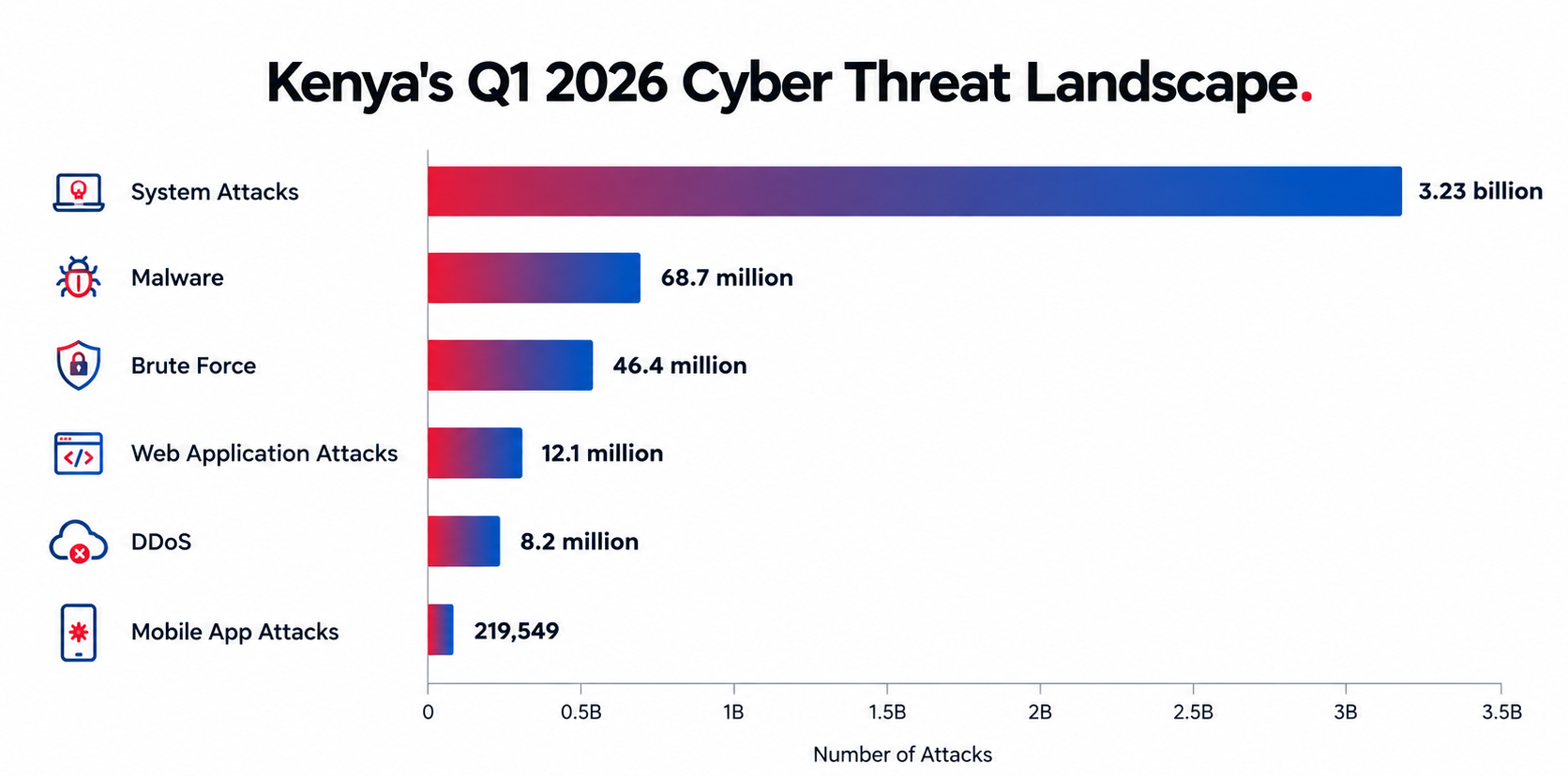
Kenya’s businesses are under attack, literally, billions of times a quarter. Between January and March 2026 alone, the National KE-CIRT/CC detected 3.37 billion cyber threat events targeting Kenyan organizations, according to the Communications Authority of Kenya. System-level attacks made up 96% of that volume, malware attempts climbed 3% quarter-on-quarter, and ransomware groups continued listing Kenyan companies, from banks to government agencies on their leak sites.
If your business runs on email, mobile money, cloud storage, or a single unpatched server, you’re already a target. The good news: most breaches are preventable with the right checklist, applied consistently. Here’s the one we use to protect the banks, telcos, and government institutions we work with every day.

Why This Matters Right Now.
Kenya’s threat volume has been swinging wildly from 657 million events in late 2024 to a record 4.6 billion in Q4 2025, before settling at 3.37 billion in Q1 2026. The drop in volume doesn’t mean the danger has eased; attackers are simply getting more targeted. Financial institutions, ISPs, cloud providers, and healthcare organizations remain the most affected sectors, and CA attributes the continued exposure to three recurring gaps: poor patching discipline, low staff awareness of phishing, and the growing use of AI by attackers themselves.
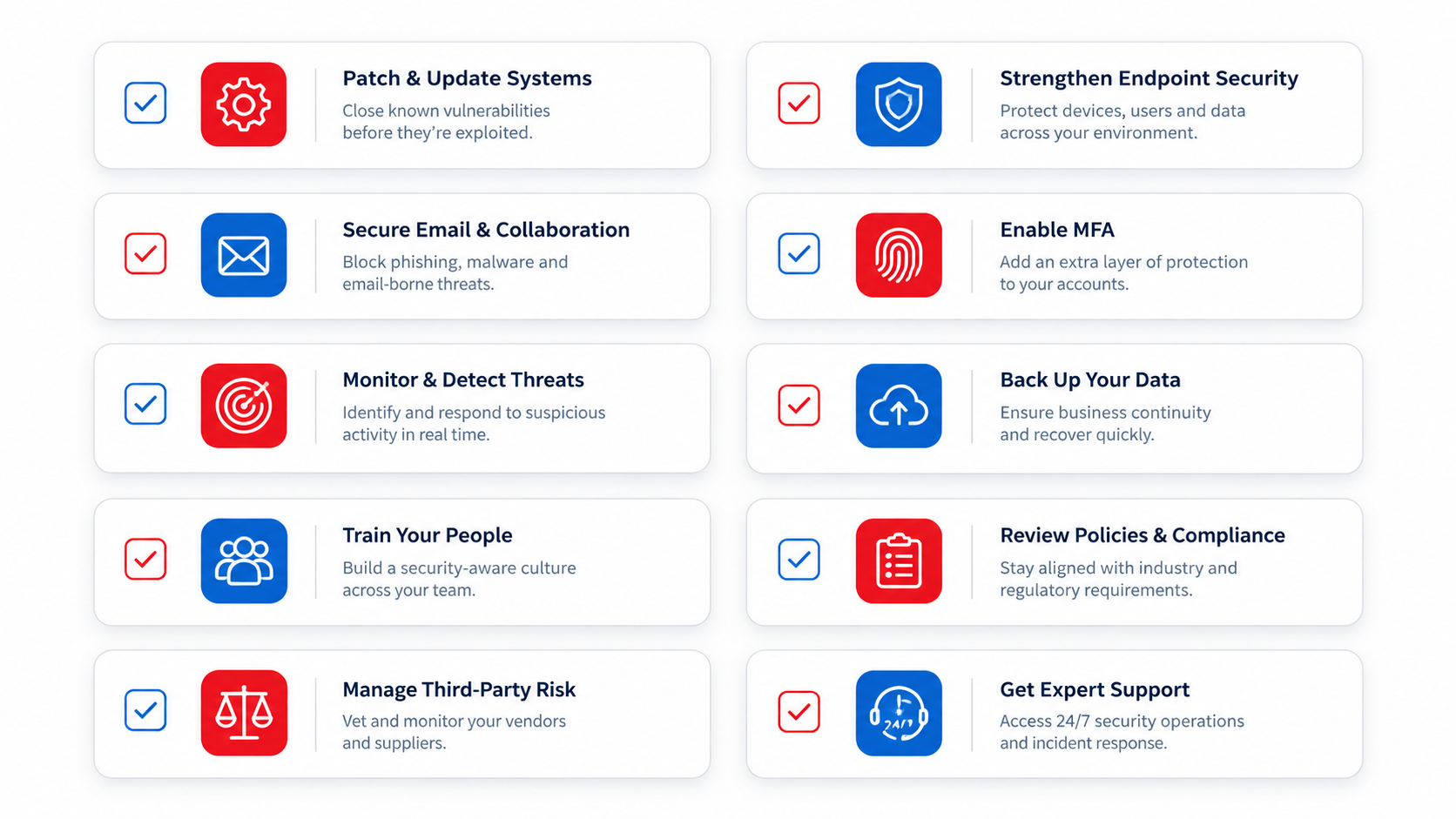
The 2026 Enterprise Cybersecurity Checklist.
- Patch and update relentlessly.
- Unpatched systems remain the single biggest door attackers walk through in Kenya. Automate patch management for servers, firewalls, and endpoints don’t wait for a quarterly IT cycle.
- Deploy Endpoint Detection & Response (EDR/XDR).
- Antivirus alone won’t stop today’s ransomware. XDR platforms catch and contain threats in real time, across every device on your network.
- Lock down email – your #1 attack surface.
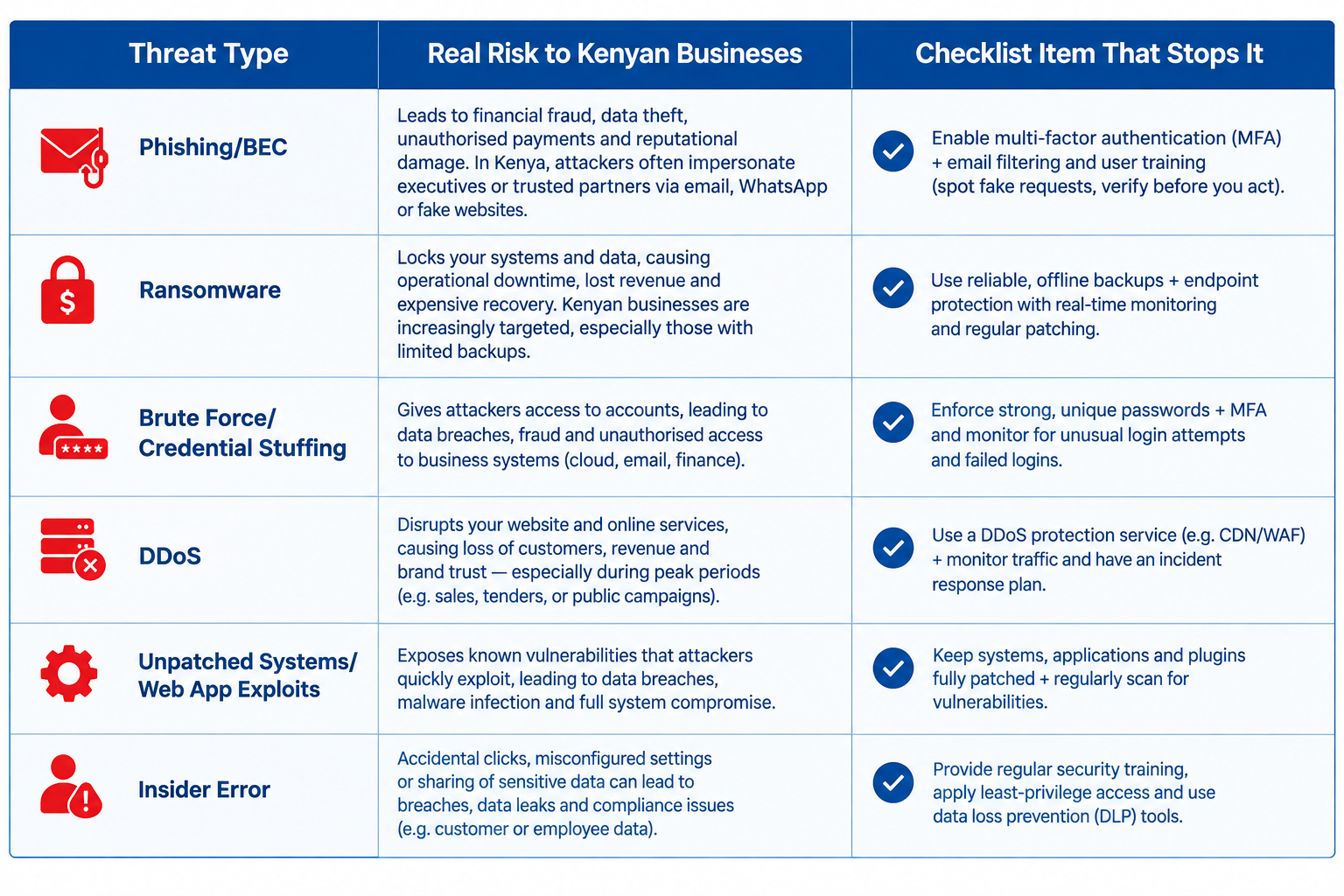
- Phishing and business email compromise remain the easiest way in. Layer in email security, staff simulation drills, and archiving for compliance.
- Enforce multi-factor authentication (MFA) everywhere.
- Passwords alone are not protection. MFA should cover email, VPNs, cloud consoles, and financial systems without exception.
- Monitor your external attack surface.
- Attackers scan the internet for exposed servers, forgotten subdomains, and misconfigured cloud buckets before you even know they exist. Continuous External Attack Surface Management (EASM) closes that gap.
- Secure and test your backups.
- Ransomware recovery lives or dies on backup integrity. Back up critical data off-network, encrypt it, and actually test restoration not just the backup job.
- Train your people, not just your systems.
- Most breaches start with a click, not a hack. Regular, practical staff awareness training turns your team into your first line of defence.
- Build (and rehearse) an incident response plan.
- When not if an incident happens, minutes matter. A documented, rehearsed response plan is the difference between a contained event and a headline.
- Align with the Kenya Data Protection Act.
- Compliance isn’t just legal box-ticking, it forces the security hygiene (access controls, breach notification, data minimization) that keeps you resilient.
- Get a partner who watches 24/7 – because attackers don’t sleep.
- With billions of threat events hitting Kenyan networks every quarter, no internal team can watch everything alone. Managed, round-the-clock monitoring is no longer a luxury; it’s baseline infrastructure.
You Don’t Have to Do This Alone.
We’ve spent over a decade building cybersecurity resilience for organizations like Safaricom, Equity Bank, KCB, and NCBA Bank, deploying EDR/XDR, threat hunting, and 24/7 monitoring that stands up to Kenya’s real-world threat volume. Whether you’re a growing SME or an enterprise with a lean IT team, we scale our expertise to fit your risk, not the other way round.
Talk to us before an attacker does.
📍 Visit: www.crystaltech.co.ke
📧 Email: info@crystaltech.co.ke
📞 Call: (+254) 111 180 000

 Chat with Us